KVA: Capital Valuation Adjustment#
Capital Valuation Adjustment, or KVA, is the cost of holding regulatory capital against a derivative over its life. A bank has to hold capital against the risks in its derivative book, and that capital is funded by shareholders who require a return. KVA is the present value of that required return.
Where CVA, FVA and MVA are costs that come from the market, KVA comes from regulation. It is the adjustment that answers the question: what return does this trade earn on the capital it consumes?
Where the capital comes from#
A derivative can attract capital under several regulatory charges:
Charge |
What it covers |
|---|---|
Counterparty credit risk (SA-CCR) |
The default risk of the counterparty on the current and potential future exposure. |
CVA capital |
The risk of mark-to-market losses from changes in the counterparty’s credit spread, calculated under the standardised (SA-CVA) or basic (BA-CVA) approach. |
Market risk |
The risk from moves in the underlying market factors, for the part of the position that is not hedged. |
Leverage ratio |
The balance sheet size of the exposure, which can bind for low-risk, high-notional trades. |
The capital is not a single number at the start of the trade. It changes as the exposure runs off, the market moves and the trade approaches maturity, so the calculation needs the future capital profile.
How it is calculated#
KVA is the discounted cost of the capital held at each future date:
where \(\text{E}[K_t]\) is the expected capital requirement at time \(t\) and \(h\) is the hurdle rate: the return in excess of the risk-free rate that shareholders require on that capital.
The steps are the same as for the other adjustments, with a capital model in place of the margin model:
Simulate the exposure and the market factors over the life of the portfolio.
At each date and path, calculate the regulatory capital that would be required under each of the charges above.
Take the expected capital profile.
Apply the hurdle rate and discount.
This is expensive, as the capital formulas are complex and rely on inputs, such as the exposure at default, that must themselves be simulated. Simplified or regression-based approximations are normally used, as for MVA.
KVA depends on assumptions that are a matter of judgement, for example:
the hurdle rate, which is a policy choice of the firm and not an observable market price
how much of the capital benefit is given to the trade for the hedges and netting held elsewhere
the future regulatory regime, as the rules change over the life of a long-dated trade
A worked example#
The script below estimates the KVA of the same 5-year payer swap as the CVA example. It replaces the regulatory capital rules with a deliberately simple model so that the mechanics are visible:
Simulate the swap and calculate the expected exposure (EE) at each future date.
Convert it to an exposure at default with a multiplier of 1.4, then to capital with a 100% risk weight and a 10.5% capital ratio.
Charge a 10% hurdle rate on the expected capital at each date, discount, and sum.
It is not a regulatory calculation. A real KVA uses the actual SA-CCR, CVA and market risk capital formulas inside the simulation.
"""Illustrative KVA for a 5-year payer interest rate swap, with a simplified capital model."""
from pathlib import Path

import matplotlib
import numpy as np

matplotlib.use("Agg")
import matplotlib.pyplot as plt

rng = np.random.default_rng(42)

# Trade and market assumptions
notional = 100e6
maturity = 5.0
steps_per_year = 12
n_paths = 20_000
rate0 = 0.03        # flat rate; the fixed rate equals it, so the swap starts at par
rate_vol = 0.01     # normal (absolute) volatility of the rate, per sqrt(year)
disc_rate = 0.03    # flat discount rate

# Simplified capital assumptions (not a regulatory calculation)
alpha = 1.4            # exposure multiplier applied to the expected exposure
risk_weight = 1.00     # 100% risk weight for an unrated corporate counterparty
capital_ratio = 0.105  # capital held as a share of risk-weighted assets
hurdle = 0.10          # return shareholders require on that capital

# 1. Simulate the rate and value the swap at each future date.
dt = 1.0 / steps_per_year
t = np.arange(0.0, maturity + dt / 2, dt)
shocks = rng.standard_normal((n_paths, len(t) - 1)) * np.sqrt(dt)
rate = rate0 + rate_vol * np.concatenate([np.zeros((n_paths, 1)), shocks.cumsum(axis=1)], axis=1)
value = notional * (maturity - t) * (rate - rate0)

# 2. Capital profile: exposure at default -> risk-weighted assets -> capital
ee = np.maximum(value, 0.0).mean(axis=0)
ead = alpha * ee
capital = capital_ratio * risk_weight * ead

df = np.exp(-disc_rate * t[1:])
mid = lambda x: 0.5 * (x[:-1] + x[1:])


# 3. KVA = sum( E[K] x hurdle x dt x DF )
def kva(h):
    return (mid(capital) * h * dt * df).sum()


kva_base = kva(hurdle)
print(f"Peak capital   : {capital.max():12,.0f}  at year {t[capital.argmax()]:.2f}")
print(f"Hurdle rate    : {hurdle:.0%}")
print(f"KVA            : {kva_base:12,.0f}  ({kva_base / notional * 1e4:5.1f} bp of notional)")

# 4. Sensitivity to the hurdle rate
hurdles = np.linspace(0.0, 0.20, 21)
kvas = np.array([kva(h) for h in hurdles])

# 5. Plot
fig, (ax1, ax2) = plt.subplots(1, 2, figsize=(11, 4))
ax1.plot(t, capital / 1e3, color="tab:purple")
ax1.set(title="Expected capital profile", xlabel="Years", ylabel="Capital (k)")

ax2.plot(hurdles * 100, kvas / 1e3, color="tab:purple")
ax2.axvline(hurdle * 100, color="grey", linewidth=0.8)
ax2.set(title="KVA against the hurdle rate", xlabel="Hurdle rate (%)", ylabel="KVA (k)")

fig.tight_layout()
out = Path(__file__).parent / "images" / "kva_example.png"
out.parent.mkdir(exist_ok=True)
fig.savefig(out, dpi=130)
Running it gives:
Peak capital   :      251,475  at year 1.67
Hurdle rate    : 10%
KVA            :       81,456  (  8.1 bp of notional)
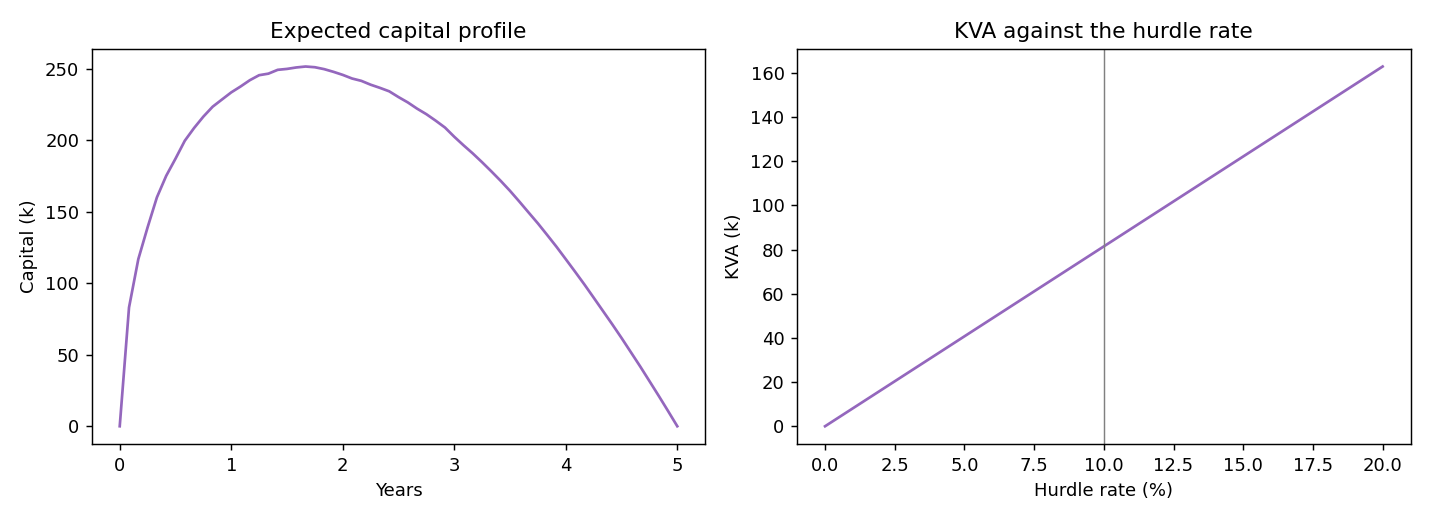
Expected capital profile (left) and KVA against the hurdle rate (right).#
Points to notice:
The capital profile has the same hump as the exposure, because the simple model scales capital with the EE. The capital is needed for the whole life of the trade and not only on day one.
KVA is linear in the hurdle rate. Moving it from 10% to 15% raises KVA by half, but it is a policy choice and not an observable market price. This is why KVA is the most contested adjustment.
In this example KVA (8.1bp) is about the same size as the CVA (7.9bp) in the CVA example, so ignoring capital would materially understate the cost of the trade.
Why KVA matters#
KVA matters for pricing and for deciding which business to do. Two trades with the same mark-to-market, the same credit risk and the same funding can use very different amounts of capital, and so earn very different returns on that capital. KVA lets the desk see this and price for it.
It is used for:
pricing, so that a trade is charged for the capital that it consumes
the return on capital of a client relationship or a business line
deciding whether to hedge, clear or compress a trade to reduce the capital
planning, to see how the new rules or a change in the portfolio affect the capital needs
Accounting treatment#
KVA is different from the other adjustments in how it is used in reporting:
it is not generally a component of reported fair value under IFRS 13, as it reflects the firm’s own cost of capital and not a price an exit market participant would charge
it is mainly a pricing and management tool, and a firm will usually keep it outside the P&L and include it in the internal charge to the desk
some firms hold a reserve or disclose it, but practice varies and is a continuing debate
Because the capital is the firm’s own and the hurdle rate is a policy choice, KVA is the most contested of the adjustments.
A valuation control view#
As KVA is mostly outside reported fair value, the valuation control focus is on governance and on consistency:
Methodology: the capital model, the hurdle rate and the approximations should be documented, approved and reviewed.
Consistency: the capital in KVA should match the capital that the firm actually reports, and the same regulatory rules should be used as for the capital calculation.
Overlap: KVA overlaps with the CVA capital and with the benefit from the DVA and funding, so the combined charge should be reviewed for double counting.
Use: the extent to which KVA is charged to desks, and whether any is booked or reserved, should be clear and consistent.